
Sliding Glass Door Hard to Open? Causes & What to Check
A sliding glass door that is hard to open may still travel from one end of its opening to the other, but moving it requires noticeably more force than it should.
That is different from a door that is stuck or has lost usable travel.
Resistance also does not identify the failed component by itself. Worn rollers are one possibility, but the same heavy or rough movement can involve the lower running surface, uneven panel support, debris, adjustment, alignment, clearance, physical interference, or several conditions acting together.
The more useful diagnostic question is not simply “Why is the door heavy?”
It is:
Where does the resistance occur, what does it feel like, and does it change as the panel moves?
Those details can help narrow down which part of the sliding system needs closer inspection.
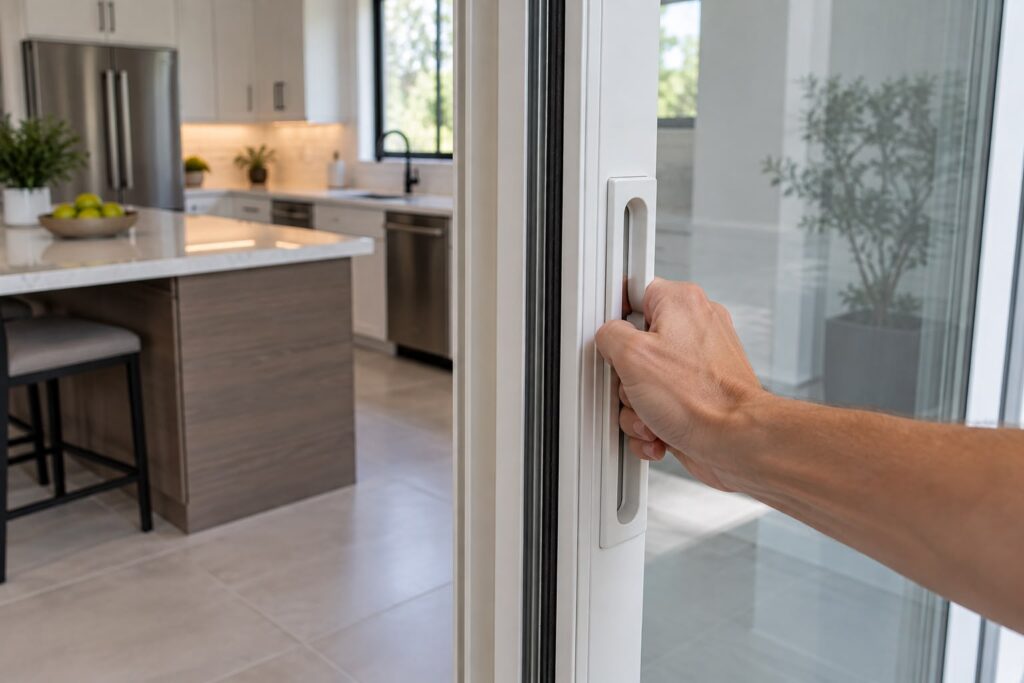
Start With the Pattern of Resistance
Before deciding what needs repair, pay attention to how the door behaves through its travel.
A door that feels consistently heavy from nearly fully closed to nearly fully open presents a different mechanical pattern from one that moves normally through most of its travel and becomes difficult only near one location.
Useful observations include:
- whether resistance is present through most of the travel or concentrated in one area
- whether the movement feels smooth but unusually heavy
- whether it becomes rough, bumpy, or uneven
- whether one area of travel produces a sudden increase in resistance
- whether the problem developed gradually or appeared suddenly
- whether the moving panel appears level as it travels
- whether the door closes against the jamb evenly
- whether there is audible scraping or identifiable physical contact
The symptom is useful because the pattern of resistance can help distinguish rolling problems from localized interference, support problems, or contact elsewhere in the system.
When the Door Rolls but Feels Too Heavy
Some sliding glass doors still move smoothly enough to appear as though they are rolling correctly, yet require far too much pulling force.
That does not necessarily mean the rollers are operating efficiently.
A roller assembly may still rotate while failing to support and carry the panel efficiently under load. Bearing wear, roller damage, poor adjustment, uneven support, or the relationship between the roller and its running surface can increase the force required to move the panel.
There is also an important distinction between rolling resistance and physical friction elsewhere on the panel.
If the roller system is not rotating or supporting the panel efficiently under load, resistance is being created within the way the panel is carried along its running path. But a panel can also continue rolling on functioning rollers while another surface or component rubs, presses, or interferes with the moving panel.
Those conditions can feel similar at the handle.
That is why a door that still rolls should not be evaluated only by asking whether the rollers turn. The inspection has to determine where the resisting force is actually being created while the panel moves.
Resistance Through Most of the Door’s Travel
When a sliding door is heavy through most or nearly all of its travel, the inspection usually needs to focus on conditions that remain active while the panel moves.
That may include the way the rollers support the panel, the condition of the running surface, adjustment, panel clearance, or continuous friction elsewhere in the system.
The important distinction is consistency.
If substantially the same resistance follows the panel across the opening, a single isolated obstruction becomes less likely than a condition affecting the panel throughout its movement.
That observation does not identify the defective part by itself, but it helps determine where the inspection should begin.
Resistance in One Specific Area
A door that moves reasonably well and then becomes difficult at one particular point presents a different diagnostic problem.
Localized resistance can direct attention toward what changes at that position.
The lower running surface may have a damaged, distorted, contaminated, or obstructed area. The moving panel may also change its relationship to another surface as it passes that point.
The exact location matters.
If resistance repeatedly begins and ends in approximately the same part of the opening, that pattern should be inspected before treating the door as though it has uniform rolling resistance.
A complete diagnosis should also consider whether the symptom follows the panel itself or remains associated with a particular location in the frame or running surface.
Rough or Bumpy Movement Is Different From Simple Heaviness
A heavy door and a rough-running door can both require excessive force, but they do not necessarily indicate the same condition.
A panel that moves with vibration, repeated bumps, jolts, or changes in height may point toward an irregular roller or running-surface interaction.
By contrast, a panel that remains relatively smooth but consistently requires a strong pull may involve inefficient rolling under load, excessive friction, adjustment, or another condition that does not create an obvious bump.
The feel of the movement matters because it helps separate how much resistance exists from how that resistance is being produced.
Roller Support and the Running Surface Work Together
Rollers do not operate independently of the surface beneath them.
The condition of the roller, the amount of load it carries, its adjustment, and the condition of the running surface all influence how easily the panel moves.
A worn roller traveling on a good surface may behave differently from a usable roller traveling over a damaged or distorted running surface. Uneven support can also change how the load is distributed from one side of the panel to the other.
This interaction is one reason replacing a component based only on the symptom can miss the actual mechanical problem.
The goal is to determine what is creating the resistance through the panel’s actual travel.
Alignment and Panel Position Can Affect Movement
Alignment problems are not limited to doors that will not latch.
Panel height, angle, support, and clearance affect the way the moving panel sits within the opening.
If the panel is positioned incorrectly, one area may sit closer to the frame, threshold, guide, weatherstripping, or another surface than intended. The resulting contact or pressure can increase operating resistance even though the door still completes its travel.
The way the door meets the jamb can provide another clue.
If the panel appears uneven when closed, meets the jamb at an angle, or requires lifting or positioning to line up correctly, the resistance and the alignment issue may be related.
An adjustment may be appropriate in some cases. In others, the panel is out of position because a roller, running surface, support component, or other mechanical condition has already changed.
Does the Resistance Change When the Panel Is Unloaded?
During a professional inspection, temporarily reducing the load carried by the roller system can help determine whether the resistance changes with panel load or position.
If movement improves while the roller system is carrying less of the panel’s load, that observation can direct closer inspection toward roller condition, support, clearance, or panel position.
It does not prove that a specific roller or other component has failed. Changing the load can alter several mechanical relationships at the same time, so the result has to be interpreted together with the door’s behavior through its normal travel.
This is a professional diagnostic observation, not a homeowner test.
Homeowners should not attempt to lift or remove heavy sliding glass panels for diagnostic purposes. Large glass panels can be extremely heavy and difficult to control safely.
Dirt and Debris Can Matter - but Cleaning Has Limits
Debris on the lower track or running surface can interfere with smooth movement.
Loose material should be removed before assuming the door needs mechanical repair, especially when visible buildup is present.
But cleaning and mechanical repair solve different problems.
If the running surface is damaged, the rollers are worn, the panel is poorly supported, or another component is creating resistance, cleaning alone will not correct the underlying condition.
Applying oil or greasy lubricant to the lower running surface can collect dirt and contamination and may temporarily mask the symptom without correcting the mechanical cause. Lubrication should not be used as a substitute for diagnosing worn rollers, running-surface damage, poor support, alignment, or physical interference.
A Sudden Change Deserves Attention
A door that gradually becomes heavier over months may reflect progressive wear or changing adjustment.
A door that suddenly becomes difficult to move presents a different situation.
A sudden change can follow debris entering the running path, damage to a roller or another component, a shift in panel position, displaced hardware, or another new source of interference.
The timing does not diagnose the component, but it helps narrow the inspection.
If the operating feel changed noticeably from one use to the next, the question becomes what changed mechanically, rather than assuming the door has simply become old or dirty.
Do Not Force a Door Through Strong Resistance
If a sliding glass door suddenly requires much more force than normal, repeatedly forcing it is not a useful diagnostic method.
Additional force can place more stress on rollers, handles, locks, the running surface, and the panel itself without identifying why the resistance increased.
If the panel still has usable travel, observe where the resistance occurs and whether the pattern is consistent.
If the door progresses to the point that usable movement becomes severely restricted or it stops, the problem has moved beyond a simple hard-to-open symptom and should be evaluated accordingly.
What a Professional Inspection Should Determine
A proper inspection should reproduce the symptom and evaluate the door as a moving system rather than selecting a repair from the homeowner’s description alone.
The technician should determine:
- where resistance begins and ends
- whether resistance is uniform or localized
- whether movement is smooth, rough, bumpy, or accompanied by contact
- whether the panel remains correctly supported and positioned
- how the rollers interact with the lower running surface
- whether adjustment or clearance is contributing to the problem
- whether another surface or component is creating friction
- whether the panel meets the jamb correctly
- whether more than one condition is contributing to the operating force
The repair should address the mechanical condition creating the resistance rather than simply making the door feel temporarily easier to move.
After the correction, the panel should be operated through its complete travel, not only through the area where the original symptom was strongest. A proper repair is confirmed by verifying that the previous resistance pattern is no longer present and that the panel moves correctly from one end of its usable travel to the other.
When Sliding Glass Door Repair May Be Needed
If cleaning accessible debris does not change the problem, the door continues to require excessive force, or the movement is becoming progressively worse, the operating system should be inspected before additional damage develops.
The needed repair depends on what the inspection finds.
That may involve sliding glass door roller replacement, track repair, or alignment and adjustment, but those are separate repair decisions – not automatic conclusions from a door feeling heavy.
TORBRIX diagnoses difficult sliding glass doors by evaluating the movement of the panel, roller support, running surface, alignment, clearance, and other possible sources of resistance before determining the appropriate repair.
FAQs
Common questions about sliding glass doors that are hard to open, including rollers, track conditions, alignment, resistance, and when professional repair may be needed.
Need another answer? Contact usWhy is my sliding glass door suddenly hard to open?
A sudden increase in resistance can involve debris or interference in the running path, a change in roller or panel support, displaced hardware, damage, or a shift in panel position. Where the resistance occurs and how the door feels while moving provide useful clues during inspection.
Does a hard-to-open sliding glass door always need new rollers?
No. Roller condition is an important part of the inspection, but resistance may also involve the running surface, alignment, panel support, clearance, debris, or physical interference elsewhere in the system.
Why is my sliding glass door hard to open only in one spot?
Resistance that repeatedly occurs in the same location can indicate a localized condition along the running path or a change in how the moving panel interacts with another surface at that point. The location should be inspected rather than assuming the entire roller system is responsible.
Can a sliding glass door have good rollers and still be hard to open?
Yes. Rollers can still rotate while resistance is being created somewhere else in the system. Panel contact, running-surface conditions, support, clearance, or alignment can increase operating force even when the panel continues to roll.
Will cleaning the track make a heavy sliding door easier to open?
It can if loose dirt or debris is interfering with movement. Cleaning will not correct damaged rollers, a worn or distorted running surface, poor panel support, alignment problems, or another mechanical source of friction.
Should I lubricate the track if my sliding glass door is hard to open?
Adding oil or greasy lubricant to the lower track is not a substitute for diagnosis. It can collect dirt and contamination, and it will not repair worn rollers, damaged running surfaces, alignment problems, or physical interference.
When does a hard-to-open sliding glass door become a stuck-door problem?
A hard-to-open door still retains usable travel but requires excessive force. If movement becomes severely restricted, the panel barely moves, or it stops during travel, the symptom is better treated as a stuck or severely binding sliding door rather than ordinary operating resistance.
Sliding Glass Door Still Hard to open?
If your sliding glass door continues to require excessive force, TORBRIX can inspect the rollers, track, alignment, panel support, and other possible sources of resistance to determine what is causing the problem.